

BYD Is the Apple of Car Making
That worries a lot of people. Rightfully so.

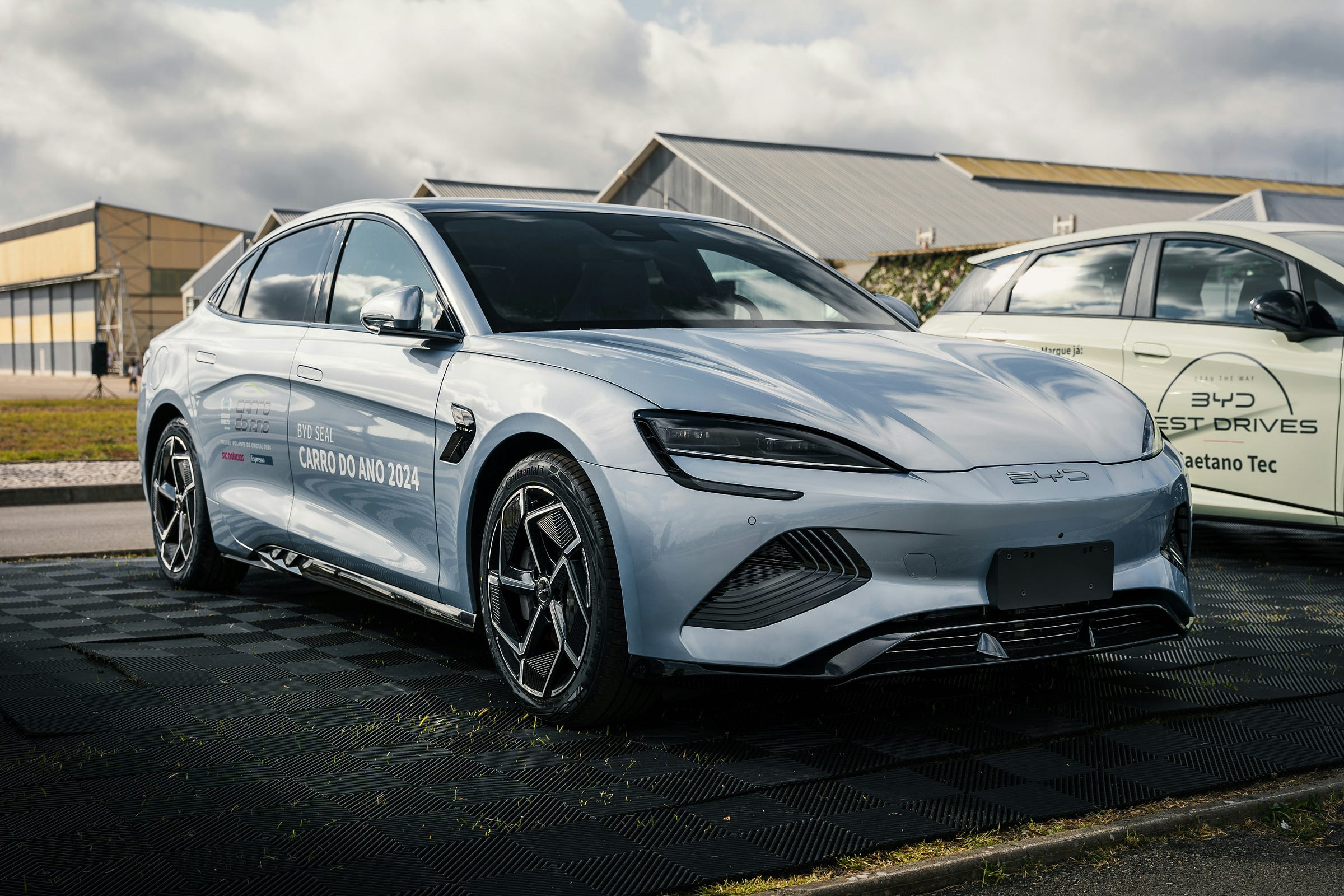
Chinese EVs are cheap because they’re cheap. You may think…
Inferior parts, corner-cutting, government subsidies lead to competitive pricing. At least, that’s probably the line you hear every time BYD comes up in conversation.
It’s wrong. Mostly. Or at least very incomplete.
Let’s take a closer look at how BYD actually builds cars, and we’ll see a different comparison show up. It’s not unlike Apple.
Why Apple?
Owning the Stack
When the iPhone launched, one of its big advantages was vertical integration. Still is.
Apple designs the chip, writes the OS, builds the ecosystem, controls the store. Every layer reinforces the next. Margins stay high. Competitors are fighting the ecosystem, not the product alone.
Look at BYD. It’s very similar.
BYD has built something pretty unique in the automotive industry, one of the most fragmented industries on earth.
The company makes around 75% of its own components in-house.
UBS pegs Tesla’s number, for its China-built Model 3, at closer to 46%.
Batteries, semiconductors, motors, battery management software, all built by BYD itself. Legacy automakers source that stuff from a scattered web of suppliers instead: Bosch for software, CATL or Panasonic for batteries, TSMC or Infineon for chips. Every one of those relationships costs money, time, and leverage.
BYD mostly skipped those relationships.
The Battery Is the Business
BYD didn’t start as a car company. It started in 1995 making batteries.
Its flagship battery, the Blade Battery, comes out of BYD’s own subsidiary, FinDreams. It uses lithium iron phosphate chemistry and a cell-to-pack design that skips the usual battery module entirely, cutting components by around 40% and improving space use by more than half compared to older LFP packs.
In the nail penetration test, the one that sends NCM batteries past 500°C and into flames, the Blade Battery rose 30 to 60 degrees. No smoke. No fire.
LFP chemistry also skips cobalt, one of the pricier materials in any battery. S&P Global puts LFP cells at over 20% cheaper than nickel-based ones.
BYD keeps all of it, because the battery maker and the carmaker are the same company. No supplier margin. No price negotiation across company lines. The savings go straight into the sticker price.
The “cheap Chinese car” argument often skips over that.
Chips and Software
The battery is only one layer.
BYD Semiconductor, founded in 2004, makes chips for battery management, motor control, and cockpit systems. When the chip shortage crushed Toyota, VW, and Ford from 2021 on, BYD shrugged. It controlled a good chunk of its own supply.
Software is the same story. Volkswagen has spent years, and a small fortune, trying to get its CARIAD software unit working. BYD builds its driver-assistance systems, infotainment, and battery software in-house. That closed loop means faster fixes, fewer integration bugs, and over-the-air updates that actually work.
Apple does this. Almost nobody else does, in any industry.
The Ships
BYD ships their cars too, obviously. All oversea car makers do. But BYD does so on boats it owns…
In 2022, BYD put around $687 million into a fleet of eight car carriers. By mid-2025 the fleet was basically done, able to move over a million vehicles a year. The BYD Shenzhen, the largest car carrier afloat, holds 9,200 vehicles across 16 decks. It sailed to Brazil for the first time in April 2025.
To be fair: BYD doesn’t build these ships. Chinese yards like Guangzhou Shipbuilding International and CIMC Raffles do, and the first two vessels were ordered by a third party, Zodiac Maritime, and chartered to BYD rather than owned outright. The BYD Hefei, launched January 2025, was the first one BYD completely owns.
So BYD is more shipowner, not shipbuilder. Worth getting right. But still… that’s miles ahead of other automakers.
Regular automakers pay market rates to shipping companies, Wallenius Wilhelmsen, Höegh Autoliners, whoever’s available. When shipping rates spike, like they did hard during COVID, that cost lands on the car price or eats the margin.
BYD removed that variable.
The ships are named after BYD’s own factory cities: Hefei, Changzhou, Shenzhen, Xi’an, Changsha.
Raw Materials Too
It doesn’t stop at the factory gate either.
In 2023, BYD picked up lithium mining rights in Brazil’s so-called Lithium Valley, its first mining deal outside China. It’s also investing in lithium refining through FinDreams, so it needs fewer outside processors.
On the other end, BYD is putting money into battery recycling, pulling lithium and cobalt back out of old packs. A hedge against the kind of price swings that hurt battery makers badly in 2022 and 2023.
The Savings Stack Up
This is system-level cost control at a scale no Western or Japanese automaker has matched yet.
Batteries come from BYD’s own plants, so no outside supplier eats a margin. Chips are increasingly its own too, which cuts exposure to both shortages and outside pricing. Software gets built in-house instead of farmed out to contractors. Shipping is moving onto its own fleet. Raw materials are getting locked in upstream.
Each layer saves a little. But they compound. And at BYD’s size, 4.27 million cars sold in 2024, overseas sales up nearly 72%, small per-unit savings turn into a real edge.
A battery pack BYD builds itself, instead of buying from an outside supplier, could run a fifth cheaper or more. That lowers the sticker price. And it funds R&D, price wars, and margins competitors can’t touch at the same price point.
In Fairness
Vertical integration needs huge capital, and it doesn’t bend easily. If solid-state batteries push LFP aside in the next decade, BYD can’t just switch suppliers the way a rival buying from CATL or Panasonic could. It has to retool factories it already built.
BYD’s retail presence in Western markets is still thin, too. And the EU’s October 2024 tariffs on Chinese EVs, 17% for BYD, more than double that for SAIC, are a headwind in one of its key target markets.
The subsidy question is murky too. BYD has benefited from Chinese industrial policy for years, and separating how much of its edge is operational versus policy-driven is hard. Vertical integration explains the structure of the advantage. It doesn’t explain how all of it got financed.
The Apple comparison has limits as well. Apple’s margins run on premium pricing BYD’s volume EVs don’t have. Apple also locks people in through software; car buyers can just buy a different brand next time. And BYD’s reputation in Europe is still a work in progress, whatever the engineering underneath looks like.
I still think what they’re building has a lot of potential and will disrupt the automotive industry quite a bit.
BYD’s plan is to become automaker #1 in a year. It’s already #3 by market capitalization.
The Bottom Line
BYD built an industrial structure, three decades in the making, starting with batteries and ending with ships.
The automakers who’ll struggle most against it don’t make worse cars. They just don’t own their supply chains. Volkswagen, Stellantis, Renault, all of them buy critical parts from markets they don’t control, pay for shipping to companies they don’t own, and negotiate with battery suppliers whose interests don’t line up with theirs.
And, crucially, those other automakers don’t build better cars than BYD either.
BYD made itself a customer of almost nobody. That’s the Apple comparison that comes to mind for me.