ChatGPT’s App Store Is Here
But What’s the Point?
OpenAI just shipped something that sounds bigger than it looks at first glance.
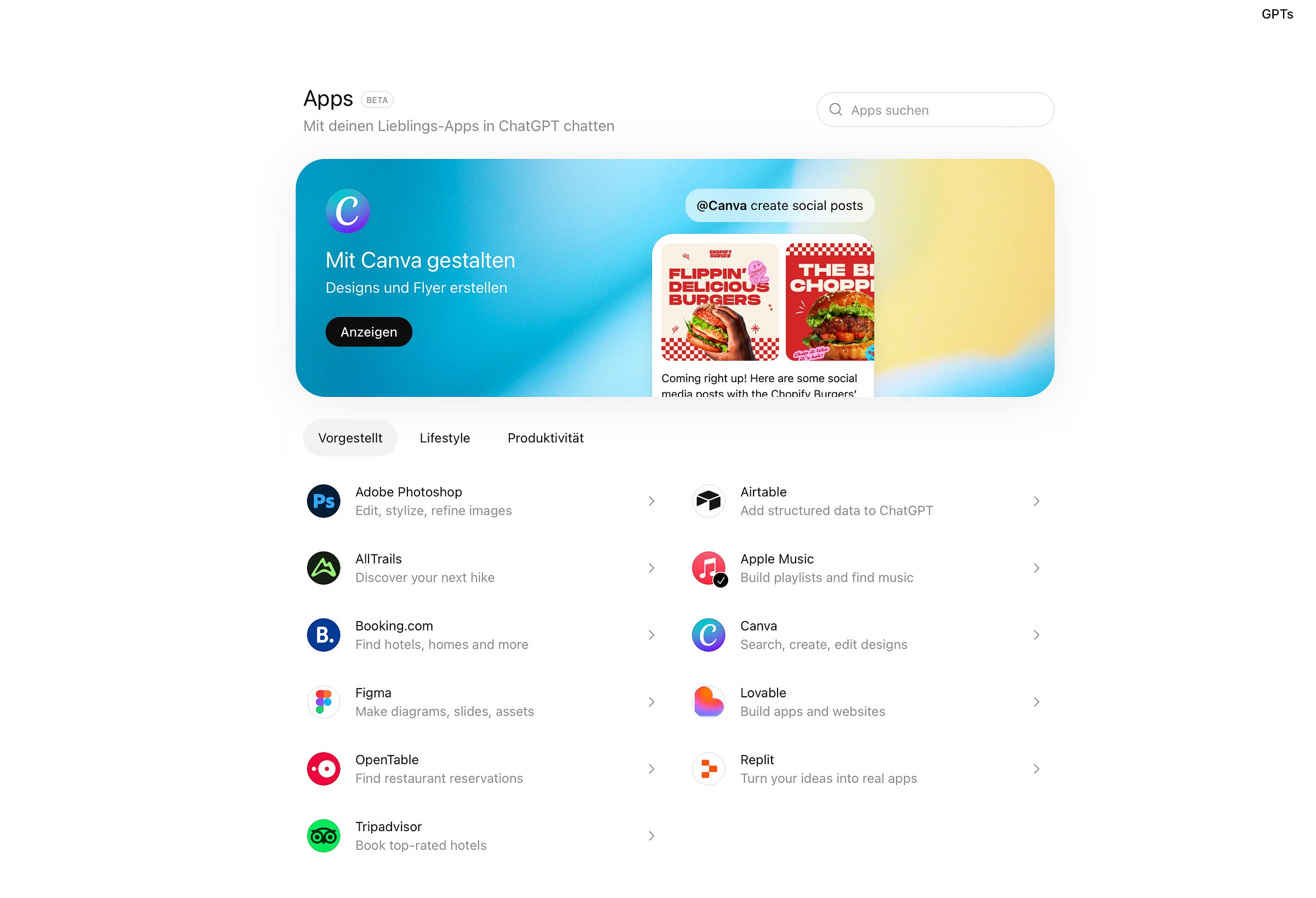
ChatGPT now has an “App Store”. Quotes intentional.
This is not an App Store in the traditional sense. No downloads.
Instead, it’s a clean list of services you can connect to ChatGPT so it can actually do things with the apps we already use. Spotify. Apple Music. Canva. Booking.com. Photoshop. Expedia. Uber Eats. Peloton. Tripadvisor.
The list will grow. Obviously.
The question isn’t what it is. The question is why it exists, and whether it’s useful or just another checkbox feature.
What This App Store Actually Is
You’ll find a new “Apps” section in ChatGPT in the app.
Click it, and you’ll see which third party services you can link. You’re not installing anything. You’re granting access.
That access lets ChatGPT pull limited data and perform actions on your behalf.
Spotify is the easiest example. Once connected, ChatGPT can:
Find podcasts on specific topics
Search for songs, artists, or genres
Play music
Create playlists
Some features require a paid Spotify plan, which is fair. No one expects miracles on a free tier.
Apple Music works much the same way. Connect it and build playlists, search, etc.
Other apps work similarly. Travel platforms can surface hotels. Design tools can help create graphics. Food delivery apps can… well, deliver food … eventually.
ChatGPT as the Hub
OpenAI is pushing ChatGPT into a role of the universal interface.
Instead of bouncing between ten apps, we ask one thing and let it talk to the others. That’s the idea.
Everything is fragmented nowadays:
One app to listen
One app to book
One app to design
One app to order
One app to decide what to watch
ChatGPT (and the other AI companies) want to sit above all of that. Not replace the services, but orchestrate them.
It’s not new. Apple tried that with Siri inside the ecosystem. Google tried it with Assistant inside their ecosystem. Amazon tried it with Alexa.
The difference now is competence. ChatGPT and modern AI can reason much better across context.
Why This Matters
Right now, the App Store is… modest.
Because the current apps are mostly “read and suggest” with a bit of action sprinkled in. But the direction is clearer.
Imagine this:
We say, “I want a long weekend in Italy in April. Somewhere warm, not too touristy. Under 150 euros a night.”
ChatGPT:
Searches Booking and Expedia
Checks Tripadvisor reviews
Suggests a location
Builds an itinerary
Saves it
And hands us links that match the plan
Then it books after a quick confirmation
That’s integration depth.
Now extend that to music, design, productivity, shopping, eventually video streaming and much more.
If Netflix, Prime Video, Disney+, and others ever plug in, we might stop scrolling through catalogs and instead ask ChatGPT, and ChatGPT recommends. Then, we jump straight in. Without ever really hitting the streaming service interface.
That’s a shift in user behavior. And if the connected apps (and their companies) actually like this is another side of the argument entirely.
The Money Question
Right now, OpenAI isn’t saying much about monetization here. They obviously want some money.
There are a few obvious options:
Revenue sharing with app partners
Affiliate style commissions
Premium placement
Paid integrations for businesses
Most likely, we’ll see a mix. First adoption. Then value extraction.
This mirrors what Apple and Google did, just inverted. They started with platforms and added intelligence later. OpenAI is starting with intelligence and adding platforms.
The Risks and Trade-Offs
Granting ChatGPT access to multiple services means… a lot of trust.
Data access, preferences, behavior. Even if permissions were scoped, this creates a powerful aggregation layer.
Who controls discovery controls leverage.
If ChatGPT becomes the default interface on our smartphones, services will start competing for visibility inside it.
Also, failure modes matter.
If ChatGPT messes up a booking, picks the wrong item, or misinterprets intent, it’s a lot worse than a simple “bad” search result.
Convenience seems to always trade off with control.
So… Is This Actually Useful Today?
Well… to me, not really.
It might save some time in small ways here and there. Playlist creation. Content ideation. Light planning. Fewer tabs. Less friction.
The real payoff will come later, when deeper actions, more personalization, and more services pile on.
More infrastructure.
And infrastructure looks boring until everything depends on it.
The Bottom Line
ChatGPT’s App Store is about position for OpenAI.
The company is trying to position ChatGPT as the layer above our digital life on our most-used devices.
The place where intent lives, and execution follows.
I bet Google, Apple, Anthropic, and others have a word to say about this, too.


It sure is friendly when bamboozling you 😁 Wouldn't trust it with my wallet. Or anything important
A very interesting article. I have used ChatGPT to help me with SO many things. I skip Google and YouTube now to solve problems because Sparky, that's what I named my Chat GPT, walks me through solutions without all of the scrolling BS. I'm planning to write a post about it soon. It's been amazing how easy it makes tasks, from dealing with my new iPhone 17 to Microsoft Word issues. I'm hooked.