

Everybody Is Wrong About the New $599 MacBook Neo
Here’s why

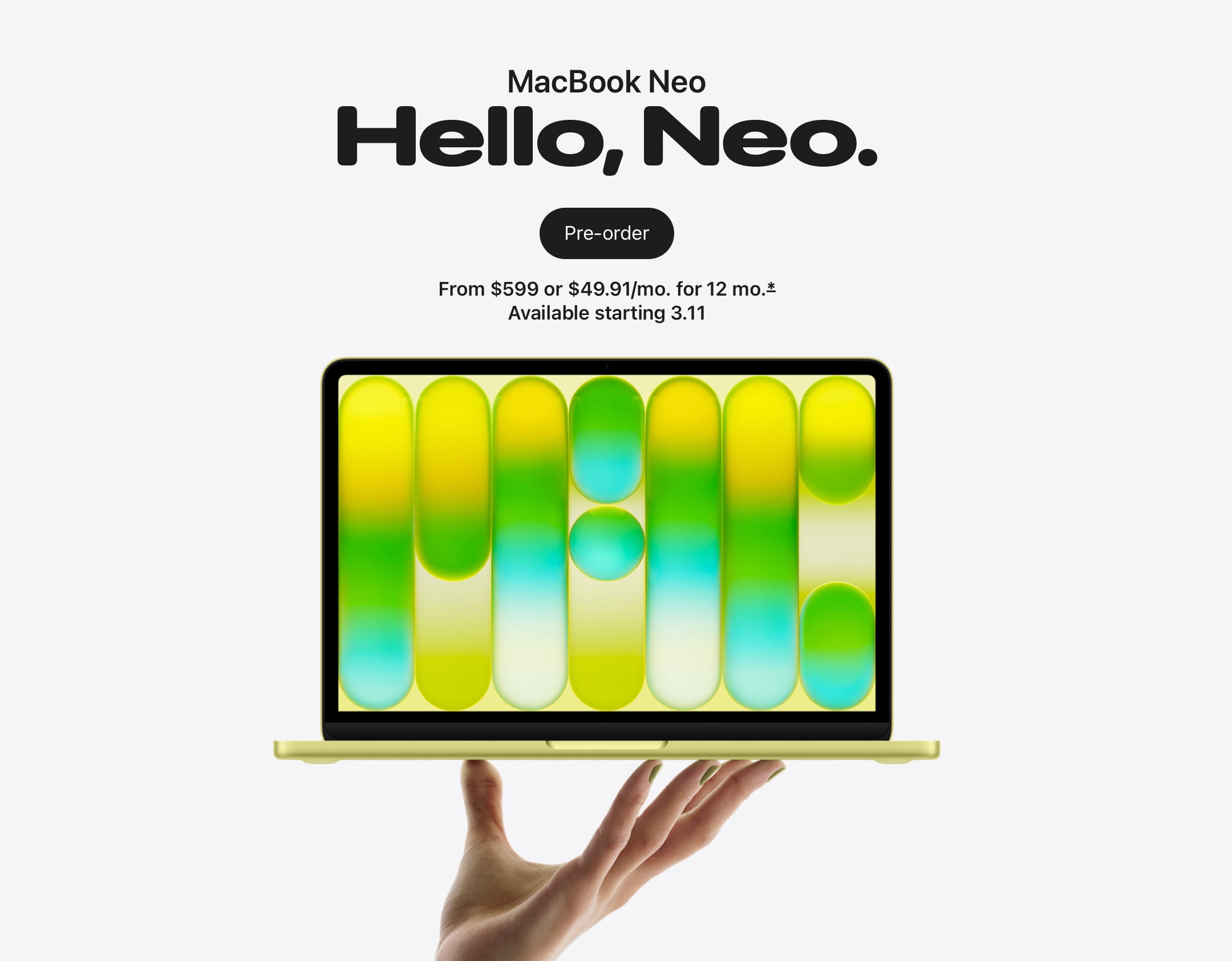
Apple just unveiled the MacBook Neo.
A $599 laptop powered by the A18 Pro chip, the same one inside the iPhone 16 Pro.
It’s Apple’s cheapest laptop ever. That already says a lot. And it’s the best-selling point of this machine. Literally.
It comes in four colors (citrus, anyone?), weighs 2.7 pounds, promises 16 hours of battery life, and has a 13-inch Liquid Retina display. Not a bad machine at all.
In fact, in this price range, it’s probably the best-built, most-capable laptop you can buy today.
So, as expected, the tech world is either calling it a revolution or a disappointment. Like always.
And most people are kind of missing the point, I think.
Yes, It’s a Chromebook Rival
To many, this new MacBook Neo is a clear Chromebook rival.
The obvious narrative writes itself: Apple wants a piece of the Chromebook market. Schools, students, light users.
And that framing isn’t wrong. It’s better than a Chromebook in so many ways. Also, the MacBook Neo starts at $499 for education customers. That’s true Chromebook Plus territory. With a lot more power and use cases, too.
But if we stop there, we’re thinking too small.
Because there’s another massive, underserved audience that few people are really talking about yet: the millions of Windows users who are quietly furious at Microsoft right now … because of the mess that is Windows 11.
Man of those are even considering switching to Linux. I’ve seen many do.
But now comes a cheap MacBook along the way…
Microsoft Created This Opportunity, Apple Showed Up to Collect
Windows 10 support ended on October 14, 2025. Gone.
No more security updates. No more patches. No more anything, unless you pay for Microsoft’s Extended Security Updates progran, which buys you exactly one extra year, until October 2026, and costs money.
And Windows 11… Millions of perfectly functional PCs can’t run it. The requirements (TPM 2.0, UEFI Secure Boot, a supported CPU family) have locked out a huge swath of hardware that was running just fine a year ago.
These aren’t “old” machines.
We’re talking about laptops from 2018, 2019, 2020. Solid, serviceable hardware that Microsoft has effectively declared obsolete.
The result is… users are stuck. And pissed!
Their PC still works, but it’s now running an OS that’s getting no security updates. Their only real options are: buy new Windows hardware, attempt sketchy workarounds that Microsoft itself warns against, pay for a temporary ESU patch, or jump ship entirely.
A lot of them are thinking very hard about jumping ship. Linux has become a trend over the past months.
But Linux isn’t the only way to go.
The Crowd Apple Is Really Whispering To
Think about who this person is that this MacBook Neo might appeal to.
They’re not a power user. They bought a mid-range Windows laptop five or six years ago. For a price below $1000 for sure.
They use it to browse the web, check email, video call family, write documents, maybe stream some Netflix. They don’t need Final Cut Pro. They don’t need 32GB of RAM.
What they do need is a computer that works. (Which Windows never does, really.)
Without forced updates that break things. Without cryptic error messages about TPM modules. Without the anxiety of knowing their machine is now essentially unpatched and exposed.
And they really didn’t have solid other choices. Chromebooks are still weird. MacBooks were too expensive. And non-techy people don’t just install Linux.
So, here comes Apple and says:
“Here’s a beautiful aluminum laptop for $599. macOS. No nonsense upgrade wars. Security updates for years. It runs the same chip as a flagship iPhone. It’s fast enough for everything you actually do. Up to 50% faster for everyday tasks than the bestselling Windows PC with the latest Intel Core Ultra 5. And by the way, it works perfectly with your iPhone or iPad.”
Intriguing…
Windows users often don’t realize until they’ve lived with a Mac for a while. macOS doesn’t hassle you. Very little.
It updates quietly in the background if you wish. It doesn’t nag. It doesn’t suddenly ask you to reboot at 2 PM in the middle of a presentation. It doesn’t feel like an OS that is constantly trying to upsell you on something.
And it’s not filled with AI… yet.
What the MacBook Neo Actually Is
The MacBook Neo is not a powerhouse. We know this. It isn’t meant to be.
8GB of RAM. There’s no option for more. On macOS, which manages memory differently than Windows, 8GB is workable, but it’s not generous.
If you’re the kind of person who keeps 30 tabs open, runs Slack, Zoom, and a few other apps simultaneously, you will feel it. It will still work. Probably still better than a Windows machine under the same load. But you will feel the 8GB RAM eventually.
And more:
No Touch ID on the base model. No MagSafe charging, just two USB-C ports. The 13-inch display is slightly smaller than the MacBook Air’s 13.6 inches. No option to expand storage beyond 512GB.
These are constraints. Apple kept costs down somewhere, and it shows.
But still. For most casual people, students, and our older generation, this is the ideal laptop!
The A18 Pro chip is impressive for what it is, an iPhone chip running a laptop. It handles everyday tasks beautifully, and its on-device AI performance is fast.
This is a computer for people who don’t need a lot of computer. And that’s actually millions of people.
The Google Shadow Hanging Over This Launch
There’s another layer here that most MacBook Neo coverage is glossing over: Google’s Aluminium OS.
Google has been building a unified Android-ChromeOS platform, internally called Project Aluminium, that would bring Android to laptops in a more serious way than ChromeOS.
The Android Ecosystem President, Sameer Samat, confirmed at MWC 2026 that they’re still targeting a 2026 debut.
The direction is pretty clear. Google wants Android on laptops, with Gemini AI baked in at the core, access to millions of Android apps natively, and tight phone-to-laptop continuity. Like Apple has.
It’s a direct answer to the tight iPhone-Mac integration Apple has built, and it’s aimed squarely at the same budget-to-mid-range market.
So, Apple didn’t wait.
The MacBook Neo lands right now, while Google’s laptop ambitions are still months (or years) away from maturity. Apple now owns the “affordable, well-made, consumer-friendly laptop” space before Google can credibly claim it.
If Aluminium OS eventually delivers on its promise, this market gets more interesting.
But for now, there’s no real Android laptop ecosystem to speak of. And Windows is a mess right now.
So Apple hits the perfect timing.
Who Should Actually Buy This?
Basically anybody who doesn’t know what RAM is.
The MacBook Neo makes a lot of sense for someone who is currently on an unsupported Windows 10 machine and would rather switch ecosystems than deal with Microsoft’s upgrade mess.
It makes sense for a student who just needs reliable, fast, well-built hardware that will last years without issues.
It makes sense as a second computer, a travel machine, a “just get things done” device.
It makes less sense for anyone who needs robust multitasking, does any kind of tough content creation (with complex video editing with pro software), or heavily relies on Windows-specific software.
The app compatibility story on Mac has improved massively over the years, but it’s not seamless for everyone.
And it’s worth noting: $599 for an Apple product still isn’t cheap in absolute terms.
A capable Chromebook can be had for $300.
The value proposition isn’t raw affordability, of course. It never is with Apple. It’s the combination of build quality, software support longevity, and the Apple ecosystem at a price point that’s new for Apple (users), even if it’s not new for the category.
The Bottom Line
The MacBook Neo is a smart, calculated move by Apple. One I bet was influenced by the current Windows mess.
Apple looked at the Windows 10 end-of-life catastrophe, looked at the Chromebook market, looked at Google’s looming Android laptop ambitions, and made a simple calculation: now is the right time to make the Mac accessible to people who never considered it before.
The “everyone is wrong” framing in this headline is of course a provocation, but partly real.
Apple is offering a well-built, long-supported, genuinely capable machine to a crowd of users that Microsoft has spent years frustrating, basically.
The timing is not accidental. And that will show!
Do you think that this is also because of second hand renewed/refurbished macbook airs sold on Amazon etc? I bought one ( Im using it now as I type ) in 2024 when my old one crashed. I love gold so ended up with one slightly older than the one that crashed but gold.It still works perfectly even with all of the photos,heavy downloads etc as I use it for my jewelry business. The prices for renewed are really good and this new model does compete with them price wise. Brilliant idea from apple to do this since it also makes a great back up to have around.