

A Chinese AI Model Beat the Mighty Fable 5
Or did it?

My Medium friends can read this over on Medium.
Moonshot AI dropped Kimi K3 on July 16, and by the next morning half my feed was making the same claim. As strong as Claude. Maybe stronger. Crazy benchmarks. For a third of the price. It's a steal. Let's switch to Kimi K3.
Some of that is true. Not all of it. So hold your horses.
The Numbers
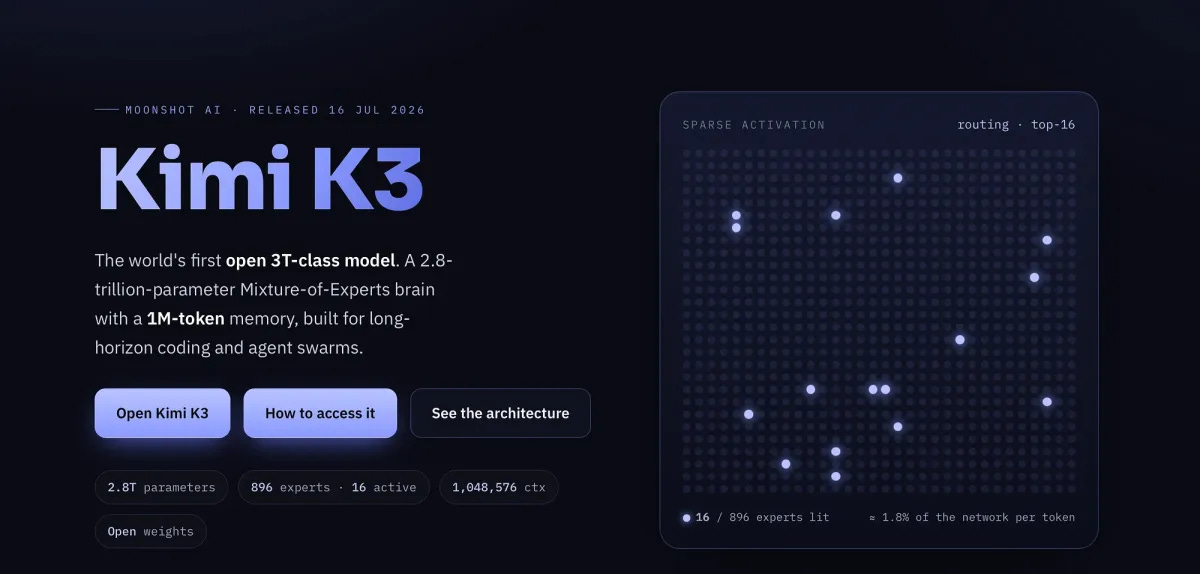
K3 is a 2.8 trillion parameter model, the biggest open-weight release yet. That's pretty remarkable.
Full weights land July 27, but the API went live on release day, and Artificial Analysis already ran it through their Intelligence Index. Score: 57. Rank #4 out of 187 models.
Just behind Claude Fable 5, ahead of Claude Opus 4.8.
On a few specific benchmarks it does better than "just behind." K3 beats Fable 5 on Terminal-Bench 2.1 and SWE-Marathon, both agentic coding tests. Incredible, right? It is!
On the WebDev Arena leaderboard, the one that scores frontend code output, K3 scored 1679 against Fable 5's 1631. A real win, not a rounding error.
So the headline isn't wrong in that sense. K3 is close. On some tasks, closer than close. To Fable 5 and also GPT 5.6.
But there's more to the story.
Speed
Kimi K3 gets less impressive here. K3 outputs 62 tokens per second. The median for models in its price tier is 73.7. Time to first token: 1.99 seconds, not fast for an API call you're about to run in a loop.
Matching Claude on intelligence and trailing the field on speed is a real trade.
I use Claude Code daily, after going back and forth between it, Antigravity, and Codex, and a model that thinks well but drags on output changes how a session feels.
Especially a long one.
The Token Problem
K3 is chatty. And thus, token-hungry.
In Artificial Analysis's eval suite, it generated 130 million tokens finishing the same tasks that averaged 63 million tokens across the field. More than double.
That's actually an improvement. Wild! K3 uses 21% fewer output tokens than its predecessor, K2.6. Moonshot is working on it. But 21% off double is still roughly double.
Now the math.
K3 costs $3 per million input tokens and $15 per million output tokens, up from K2.6's $0.95/$4 and now sitting at Sonnet-tier pricing. Fable 5 charges $10 input and $50 output. On paper, K3 runs about a third of Fable 5's price per token.
But price per token isn't what you pay. Price per finished task is. If K3 needs twice the tokens to get there, that "third of the price" number shrinks toward two-thirds or even less. A third of the price times double the tokens is not a third of the price anymore.
In some tasks with loops or review rounds, it can get even more expensive than Fable 5 and especially GPT 5.6, which is very affordable for the power it packs.
So the speed and token consumption: for a single prompt, that's annoying. For an agentic coding session, the kind K3 is explicitly built for, sustaining long engineering runs and orchestrating terminal tools, it compounds. Every extra token in every tool call adds up over a session that can run hundreds of turns.
The $0.30 cache hit rate, a 90% discount, softens this some. Heavy agentic use leans on caching hard, and K3's 1M token context window gives you room to do it. But caching offsets repeated context, not the extra tokens the model generates fresh every turn. The verbosity problem doesn't go away because you're caching the prompt.
Downsides
Cost first, since that's the whole point of this one.
The "one-third the price" headline is a per-token number, not a per-task one. Run your own numbers before you move a production pipeline over.
Full weights aren't out yet. Anyone wanting to self-host is stuck with the API until July 27.
R&D World reported getting rate-limited testing K3 in the days after launch. Early demand on a brand-new API, probably not permanent, but worth knowing if you're planning to lean on it this week.
The Bottom Line
K3 earns its benchmark wins. Beating Fable 5 on WebDev Arena and Terminal-Bench is a strong result from an open-weight model, not a cherry-picked one.
But the "third of the price" claim needs an asterisk next to it. Run the same job on K3 and Fable 5, and the gap between cheaper and cheaper enough to matter depends entirely on how many tokens it burns getting there. Sometimes that gap disappears pretty quickly.
I'll probably try it once the open weights land. Not switching anything yet.