

My $0 Marketing Stack That Actually Works
No ads. No funnel software. No email tool you pay $49/month for.


I spend $0 on marketing. Thank God!
Not a cent on ads, not a dime on ConvertKit or Mailchimp, not a monthly fee for a landing page builder.
And my content reaches more people now than it did when I was trying to do all of that (and paying for it).
It’s not a flex. It took a few years to get here. And my stack is nothing special, no “clever hack”.
It’s three free platforms (in systems) doing what they’re built to do.
The three layers
My entire marketing runs on Medium, Substack, and Google. That’s it.
I used to rely on Twitter, some LinkedIn, EmailOctopus, then MailerLite, then Kit, even tried Twitter Premium, Pinterest (ads), and more.
Didn’t enjoy any of that.
So, I stuck with 3. Medium is for discovery and audience growth. Substack is for control and audience retention. And Google is for compounding.
Each one does a different job. And they feed into each other.
Medium is #1
It’s the first writing platform I used when I started writing in English (instead of German), and the first one I made money on.
To be fair, I do pay for the Medium membership. So, technically I do spent a few bucks a month. But that is optional.
Medium does what it does best. Surface stories to new readers. Medium has a built-in audience. Millions of readers. An algorithm that surfaces your work to people who don’t know you yet. A recommendation engine. A Boost system. Perfect for starters.
You don’t have to build an audience from scratch on Medium. The audience is there, browsing. My job is to write something people stop browsing for.
That’s the discovery layer. Someone reads a story, likes it, maybe follows you. Maybe clicks through to your profile. Maybe reads two more. Might click on a link to my newsletter or on other links (affiliate, digital products, etc.).
And I get paid for all of that. Not a lot per story, necessarily. But consistently, over time.
Medium is not the whole business. It shouldn’t be. It’s only the first step.
Substack is #2
Every reader who finds me on Medium and subscribes to my Substack newsletter becomes “mine”. A member of my email list. That is pretty cool. And also more controllable.
An email address I own. A reader who sees my name in their inbox. No algorithm standing between us.
Substack is free to use. Free to publish on. Free to build an email list with. And it’s a great blogging platform on top of that.
That second part is what many newsletter writers miss(understand). Substack isn’t just for email. It’s a website. With a URL. With pages Google can index. I believe, it’s a blog first, newsletter second.
So, Medium and Substack. I use both platforms together, and the combination does more than either one alone. Medium brings new readers. Substack keeps them. Both help me with growth and retention. And with SEO.
Speaking about SEO…
Google is #3
We writers often think about algorithms, don’t we?
The online writing world is full of algorithms.
Medium’s feed, Substack’s recommendations, social media engagement. All of those are real. All of those reset to zero every day, pretty much.
But Google doesn’t reset.
A story that ranks on Google today will still bring readers next month. And the month after. And a year from now.
That’s compounding traffic. The kind that makes your old work keep working for you while you write new things.
I didn’t take SEO too seriously for a long time. Because… well, it’s not really fun.
I thought it was a technical thing for marketers with keyword tools and backlink strategies. And it can be.
But it’s not only that. It’s also about writing things people are searching for and giving Google a clean page to index. Without “hacking” your way up a keywords tool.
Substack pages are clean. Google starts liking them more and more. Medium has always been pretty well set up for SEO. So, both are good spots for low-key SEO.
If you connect a custom domain to both, set up Google Search Console and write with even a little bit of search intent in mind, your Medium posts and/or your Substack posts start showing up in search results. Depending on how you do and want it.
Paywalls are one thing to consider here.
Google indexes the title, maybe the first paragraph, and then the wall blocks the rest.
That’s one of the reasons I’ve been rethinking my paywall strategy lately.
The connection
Here’s how the three connect.
I write a story. Publish it on Medium (paywalled, earns money). Cross-post it on Substack (often free, earns subscribers).
Google indexes both or one of the two.
Medium’s algorithm pushes the story to new readers. Some of those readers subscribe to the newsletter. The Substack version ranks on Google for long-tail keywords. New readers find it through search, weeks or months later. Some of those subscribe too.
The email list grows. The search traffic grows. The Medium following grows. All of it feeds into the next story I publish.
And I paid $0 for all of it.
What about paid tools
I’ve tried them. ConvertKit. MailerLite. Landing page builders. Paid SEO tools. Social media schedulers.
None of those are bad. I just don’t like or need them.
Most of them solved problems I didn’t really have. Or solved them only slightly better than the free version.
ConvertKit is great. I’m not saying it isn’t. But Substack does the same core job for free: collect emails, send newsletters, build a web presence. I don’t need massive email automation and sequence systems. I have a few simple automation set up with Gumroad. That’s an entirely different side of the story.
But for now, if you’re starting out, or even if you’ve been at this for a while, the paid tool isn’t what’s holding you back.
What’s holding you back is probably not publishing enough or on the best platforms with a simple system. Or not thinking about search at all.
No tool fixes that. Free or paid.
The one thing I do need to invest
Time. A lot of it.
This stack doesn’t work in a month. It barely works in six. The compounding only kicks in after you’ve built up enough content for Google to notice you, enough stories for Medium’s algorithm to understand what you write about, and enough newsletters to start ranking and growing paid subscribers.
I’ve been going at it for years. Many years. With breaks. With setbacks. With months when I wrote almost nothing. And wanted to quit.
But the $0 stack kept working in the background. Old stories kept getting found. Old newsletters kept being the entry point for new subscribers.
Up to the point where search has become my #1 growth stream for paid subscribers and reads.
Who this doesn’t work for
If you need results fast, this isn’t it for you.
Paid ads may be faster. Paid tools with built-in audiences may be faster.
If you’re selling a digital product or a SaaS, the Medium-Substack-Google stack isn’t your primary channel. You probably need email automation, sequences, more control, and customization.
My system works for writers and creators who build digital products on the side. Like me.
And if you don’t want to write consistently, this entire thing falls apart anyway. The system needs fuel. The fuel is publishing.
The Bottom Line
Medium for discovery. Substack for control. Google for compounding. All free. All built to work together.
Many writers spend money on tools before they’ve spent enough time on the work. I did too. The tools weren’t the progress.
The $0 stack is not a funnel. Not a growth hack. It’s just writing, publishing in the best places (in my eyes), and letting time (and SEO) do the work.
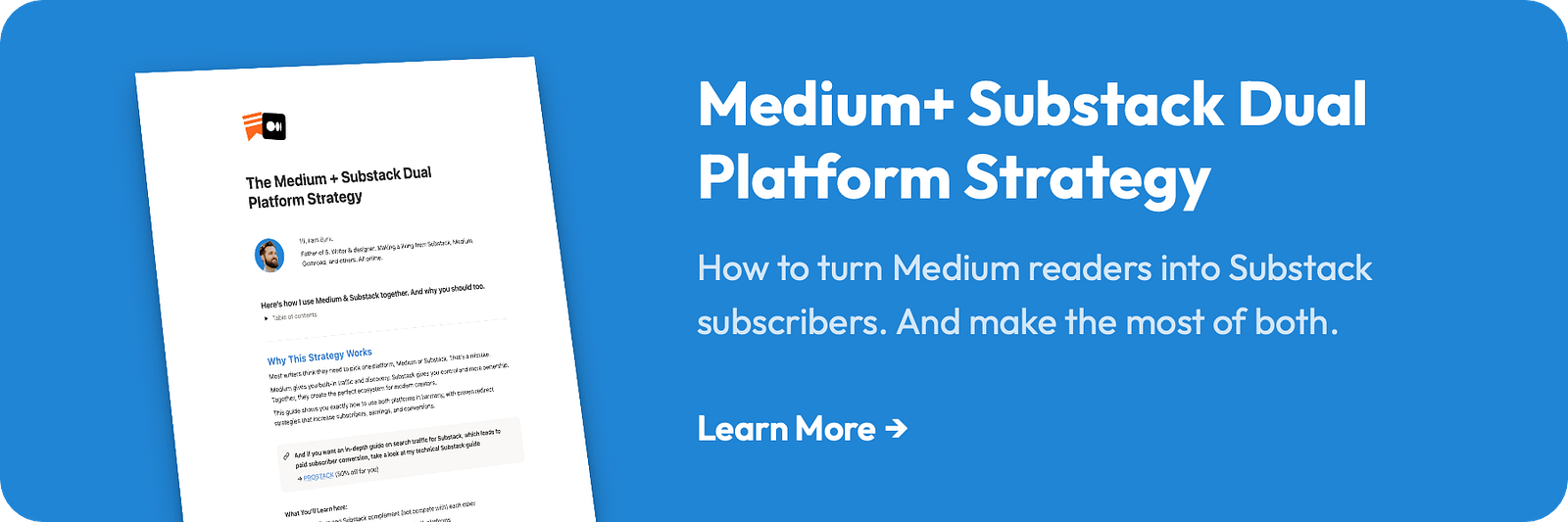
If you want to go deeper on how the two platforms work together, I put everything I’ve learned into my Medium + Substack Dual Platform Strategy guide.
do you use importvtool in medium to cross post from substack?